You stopped coding.
Don't lose sight
of the code.
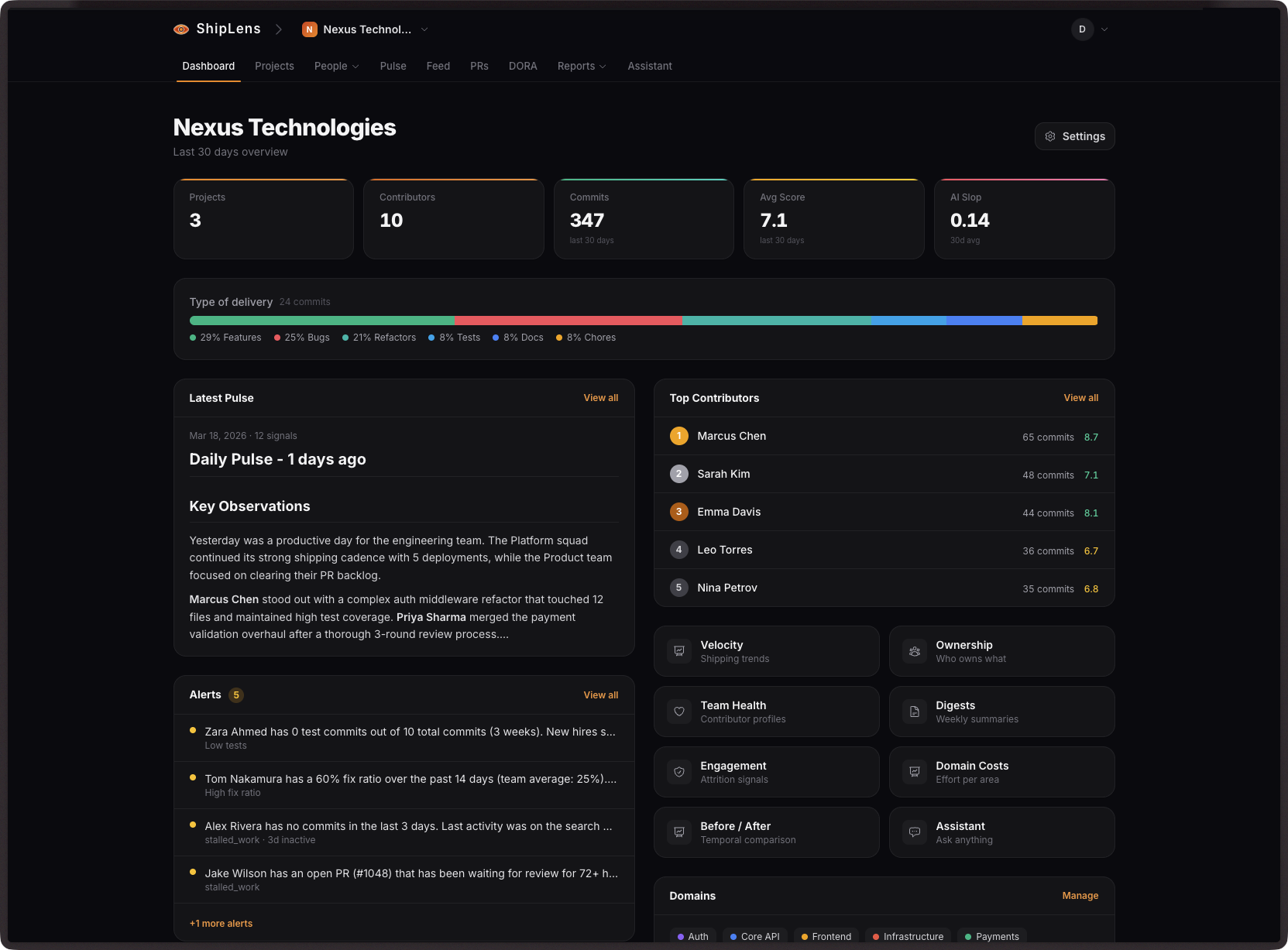
You used to review every PR. Now you manage 30+ engineers and your 1:1s run on vibes. ShipLens reads every commit the way you would — so you can lead with context, not guesswork.
The Real Problem
You can't read 500 commits a week.
Nobody can. But that's what it takes to know what your team shipped, who's struggling, and where the risk is.
1:1s without context
You walk into a 1:1 and ask "how's it going?" because you genuinely don't know what they shipped. That's not a conversation — that's an interview.
40 people, one of you
You went from writing code to managing teams. The technical intuition that got you here? It's fading with every meeting that replaces a code review.
Jira is not the truth
Tickets tell you what was planned. Git tells you what happened. A 2-point ticket might hide a brilliant refactor. A 13-pointer might be copy-paste.
"Talk is cheap. Show me the code."
— Linus Torvalds
We took that literally. ShipLens doesn't ask your engineers to fill out forms. It reads the code they already write — every commit, every diff — and tells you what matters.
Core Analysis
Your technical intuition, scaled.
The same judgment calls you'd make reviewing a PR — applied to every commit, across every project, every week.
Every commit, understood in context.
Not just "what changed" — but what it means. ShipLens reads each commit in the context of your codebase architecture, domain criticality, and project history.
Three tiers: shallow (free), standard (fast LLM), deep (agentic with codebase tools)
Quality signals: tests, error handling, clean patterns, debt reduction
Risk detection: auth changes, payment code, data model mutations flagged automatically
It learns your codebase first.
Before analyzing a single commit, ShipLens crawls your repo, maps logical domains, and builds a vector index of your architecture. A fix in payments/stripe.ex is treated differently than one in docs/readme.md.
Local embeddings: all-MiniLM-L6-v2, zero API cost, zero data leakage
Auto-detected domains with criticality levels: Critical, High, Medium, Low, Trivial
CTO overrides: you know your codebase better — adjust criticality as you see fit
AI analyzes. Rules score. Two separate steps.
Every score shows exactly why it is what it is. Change the weights, re-score everything instantly. Complexity × Impact, with domain multipliers and quality bonuses. No black boxes.
Multiplicative formula: complexity × impact × domain × quality
Configurable weights — adjust per company and re-score everything instantly
Full audit trail — every score traceable to the commit and LLM analysis
Gaming Detection
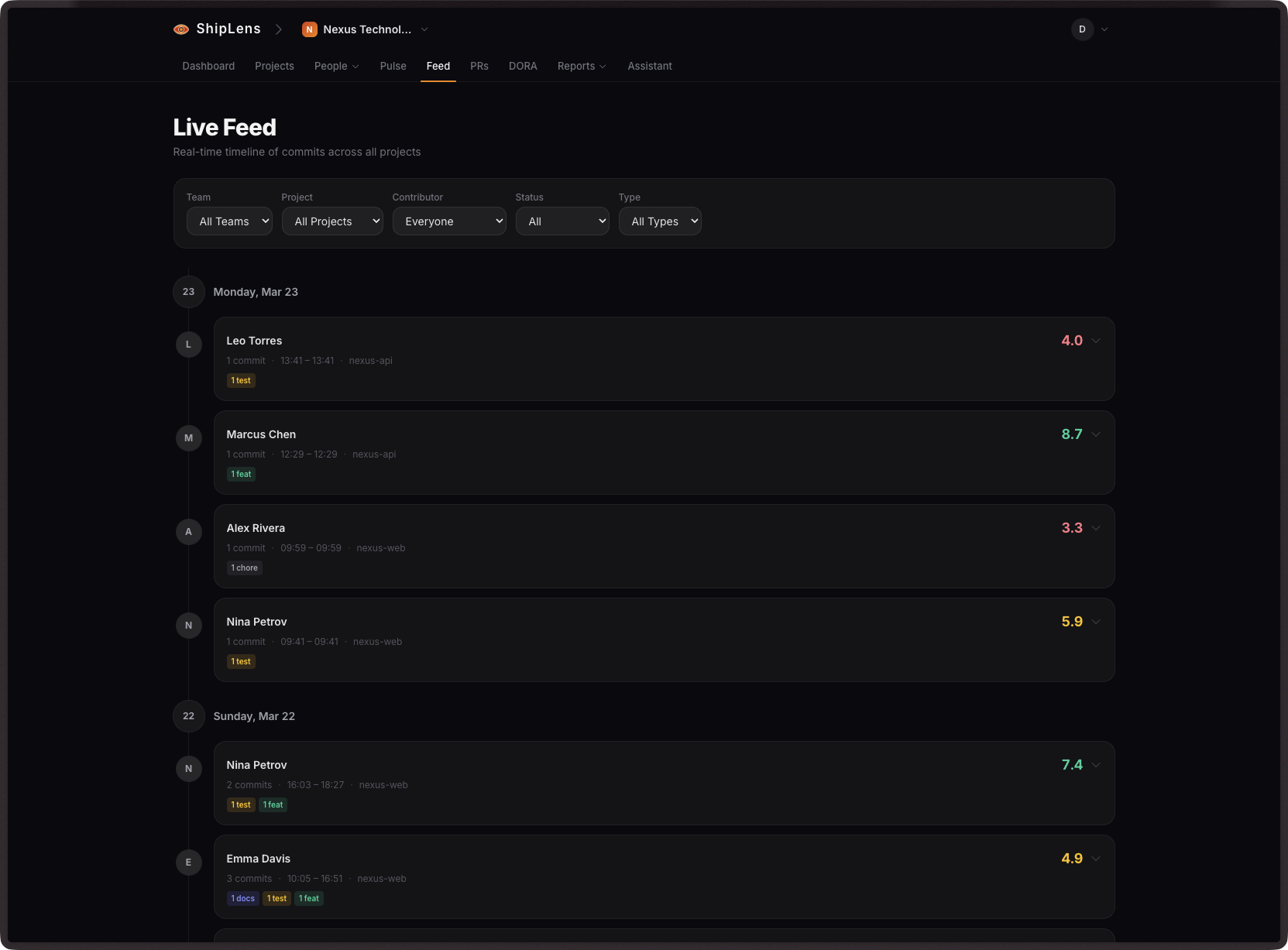
Five pattern detectors flag suspicious commit behaviors: splitting, add-remove cycles, false refactors, trivial padding. Flags only, never auto-penalizes. For coaching, not punishment.
AI Slop Detection
Seven-dimension assessment of AI-generated code quality. Measures verbosity, unnecessary comments, over-engineering, defensive bloat, style mismatch. Produces a Slop Index (0.0 – 1.0).
Work Items
Clusters related commits into logical work units. LLM-synthesized titles and summaries. Auto-links to Jira, Linear, and GitHub Issues. See what engineers built, not just commit counts.
Multi-Branch Discovery
Scans feature, release, and hotfix branches — not just main. Rebase-resilient deduplication catches cherry-picks and force pushes. Captures work before it merges.
PR Enrichment
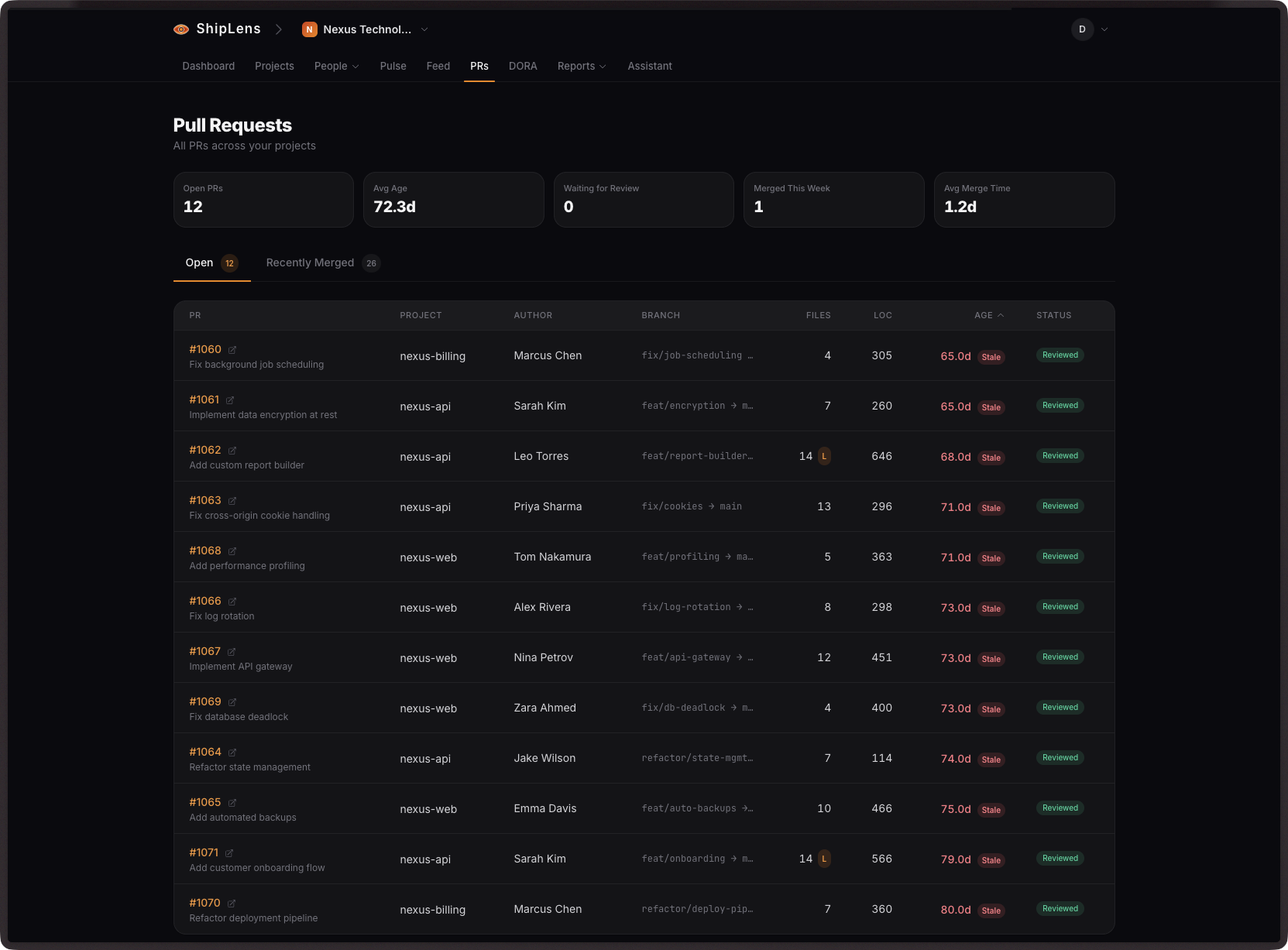
Auto-links commits to pull requests. Tracks cycle time (p50/p75/p90), review participation, comment density, self-merge ratio. Understands collaboration, not just output.
Work Patterns
Sessions, streaks, focus areas, commit sizing, peak hours. Spot the senior stuck on bug fixes for 3 weeks. Notice the junior who quietly shipped a critical refactor.
How It Works
Connect. Analyze. Lead.
No surveys. No manual tagging. No extra process for your team. Just git.
We learn your codebase
ShipLens crawls your repo, maps domains, and builds a vector index of your architecture. When it reads a commit touching payments/stripe.ex, it knows that's critical.
Every commit gets read
Merge commits? Skipped free. Regular commits? Fast LLM (~$0.002). Security-sensitive? Deep agentic analysis with codebase tools.
You get the full picture
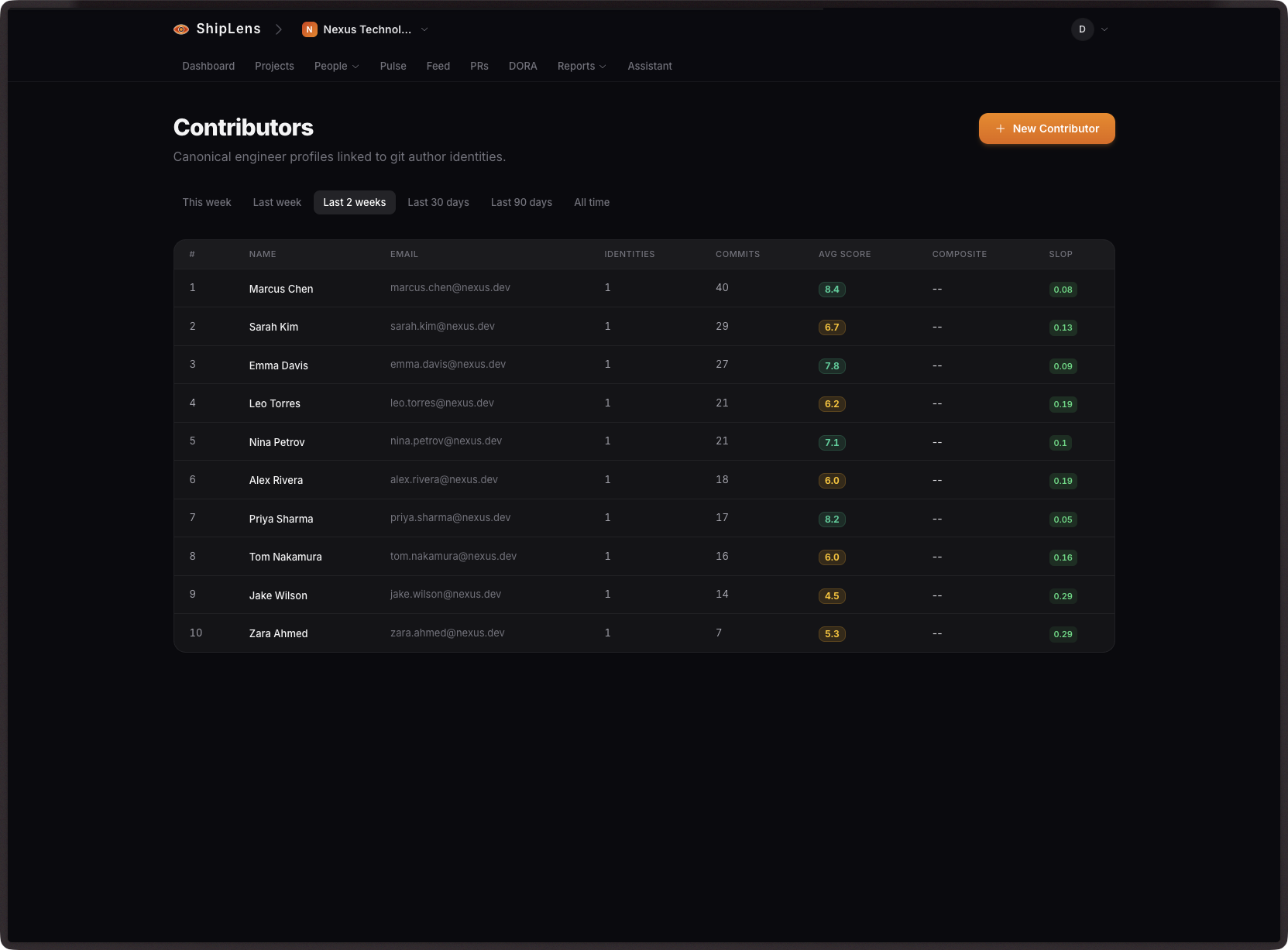
Contributor profiles, team velocity, weekly digests, 1:1 reports, alerts, forecasting, cost analysis. Delivered to you.
Intelligence & Analytics
From reactive to proactive.
Stop asking "what happened?" Start seeing what's changing before it becomes a problem.
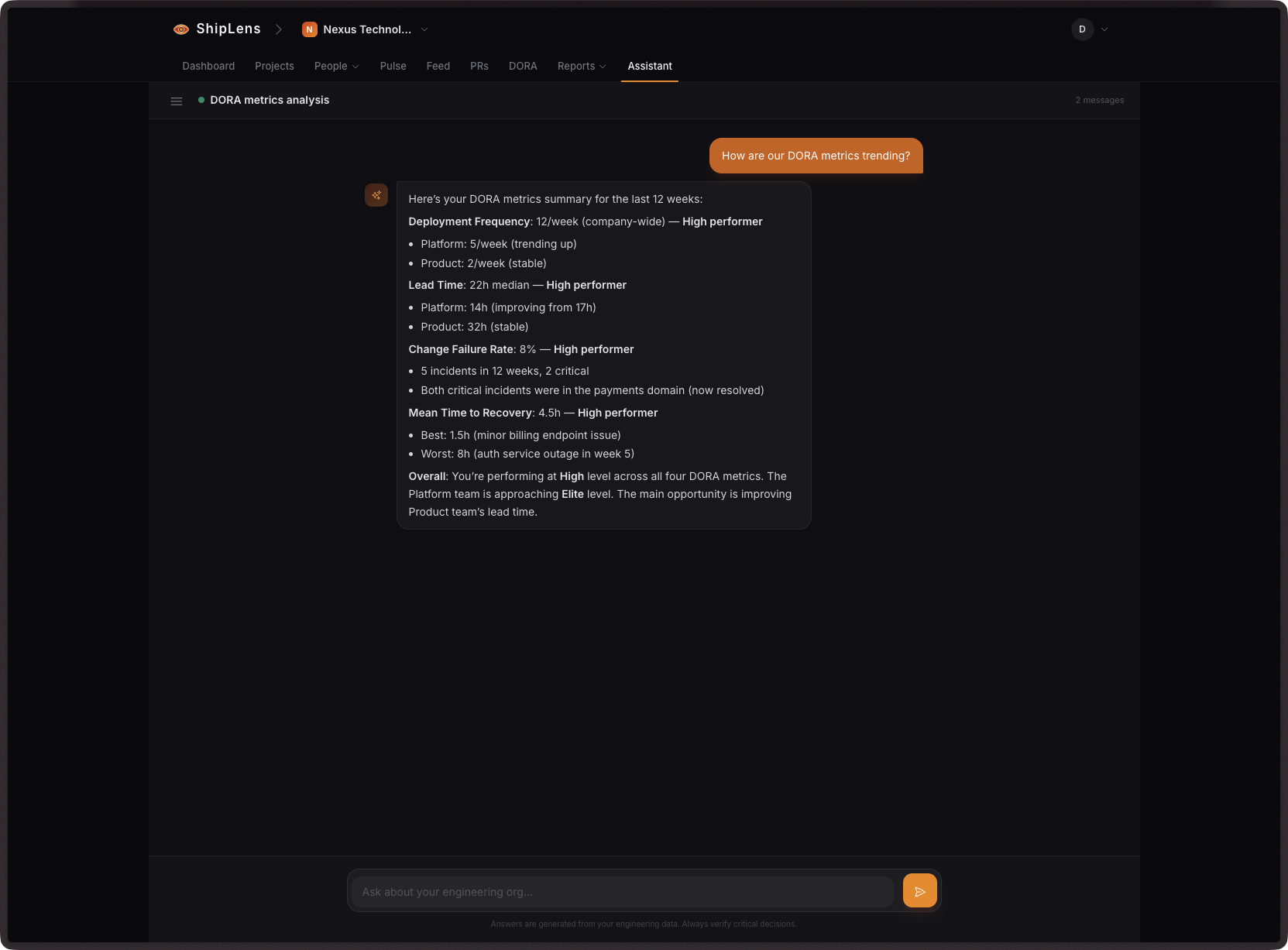
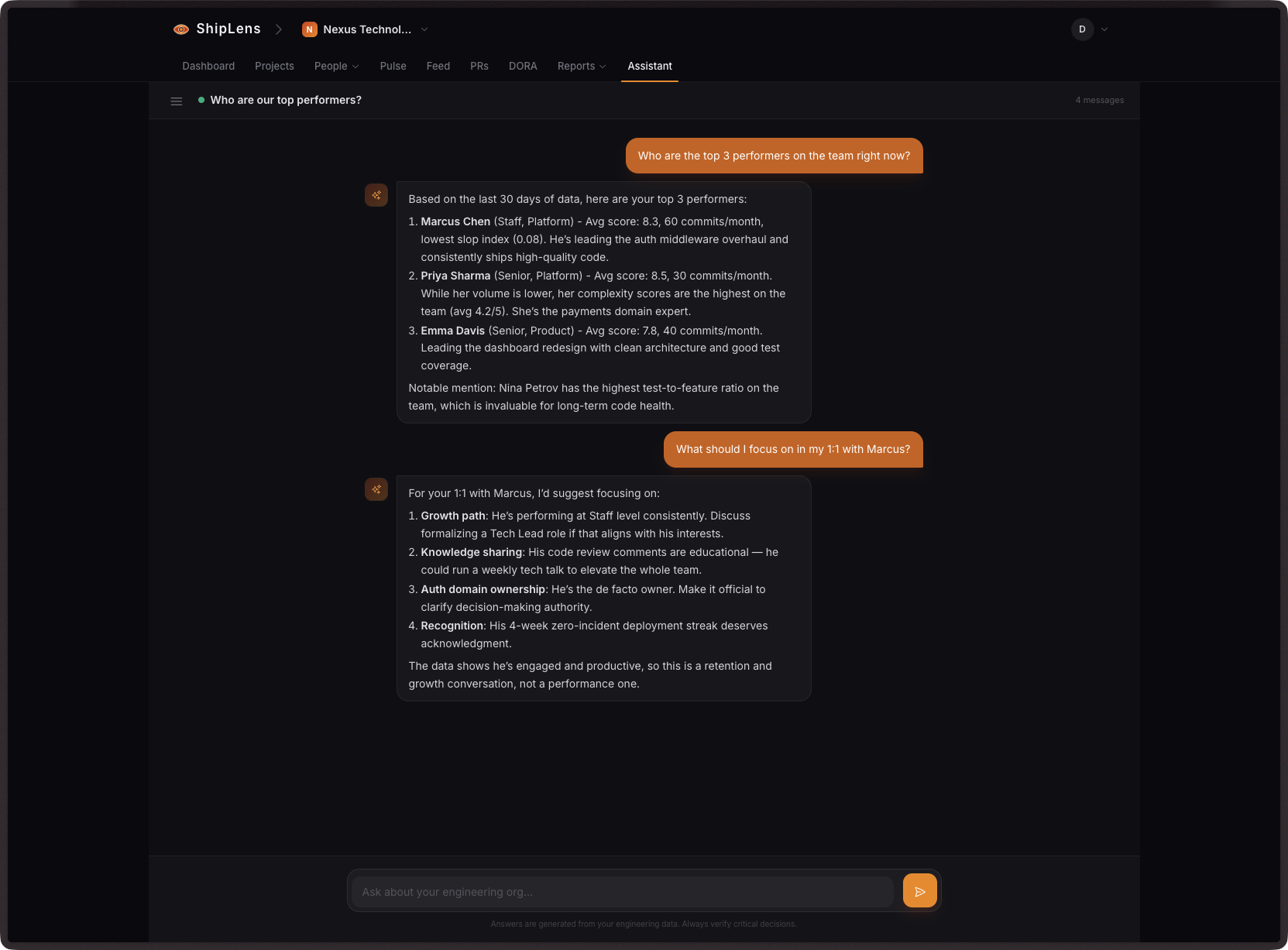
Ask anything about your team.
A conversational AI that knows your engineering data. Ask about DORA metrics, team performance, contributor patterns, or prep for your next 1:1 — all in natural language.
Monday morning clarity.
A 5-minute read that tells you everything. What shipped, what's trending, who needs attention. Compares this week to last. Delivered via Slack or email.
Forecasting
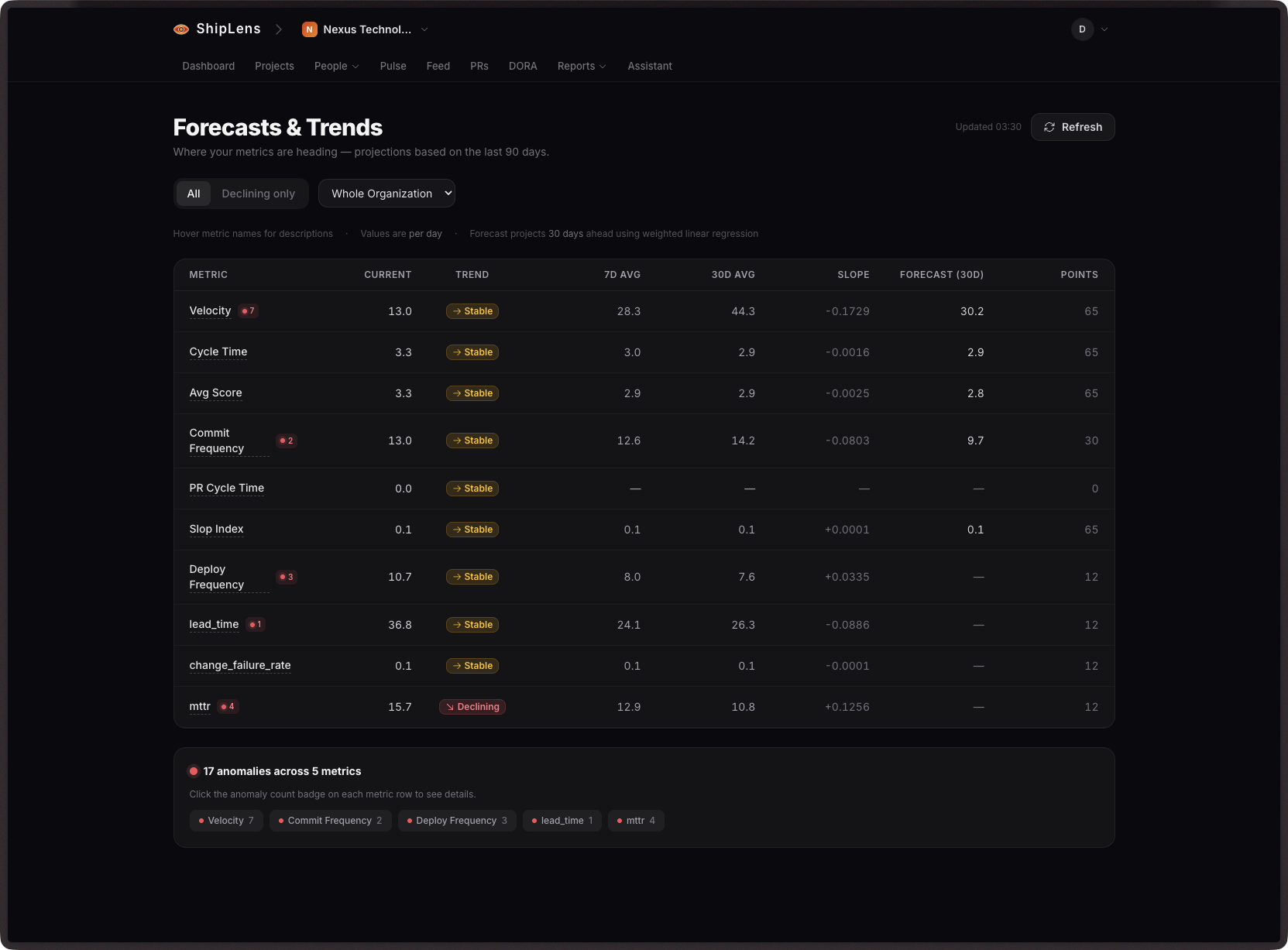
Predicts 7 and 14 days ahead with confidence intervals. Tracks velocity, cycle time, deploy frequency. Flags anomalies before they become problems.
Tech Debt
Per-domain debt scores (0–100) based on churn rate, fix density, and complexity trends. Prove your 20% debt allocation is actually working.
Cost Analysis
Connect salary data to impact. Cost per impact point, squad efficiency rankings. Encrypted at-rest, admin-only. Answer "what does a point of impact cost?"
See what's changing before it breaks.
7-day and 30-day moving averages with linear regression. Tracks velocity, cycle time, deploy frequency, slop index, and more. Anomalies flagged automatically when metrics deviate beyond 2 standard deviations.
Built for Technical Leaders
You became CTO because you're technical.
Stay that way.
You miss the code
You used to know every corner of the codebase. Now you're lucky to review one PR a week. ShipLens keeps you connected to the technical reality.
Too big for gut feel
5 direct reports? You can stay close. 30–40 across teams? You need a system. ShipLens gives you signal without adding process.
Fair to your engineers
Complex commits get deeper analysis. Trivial ones are free. Gaming and AI code are flagged for your eyes only. Trust, but verify.
Full transparency
Every score shows its breakdown. Every analysis traceable to the commit. If an engineer asks "why this score?" — you can show them.
Cost
Less than a coffee. Per week.
Most commits cost nothing to analyze. Only the ones that need AI get AI. Re-scoring is always free.
typical analysis cost
Your team's code tells a story.
You should hear it.
Connect your GitHub or Bitbucket repos and get your first analysis in minutes. No surveys, no forms, no extra work for your engineers.